Green Building

Here’s a bike shelter in Derry’s Gaelscoil. It is made with larch, and now has a wildflower-planted green roof.

Something like this?

Piers ready

Floor down, windows placed

Stud walls

OSB boards on

Larch cladding and windows

Cladding on, balcony posts in

Rubber on the roof

Grass sod roof

Roof of grass and tin

Cabin site, Ferry terminal behind, Binevenagh in distance

Happy Danny!
…………………………………………………………………………………..

Clearing the amphitheatre site
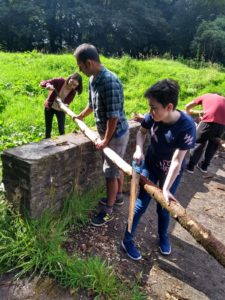


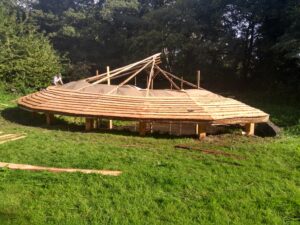
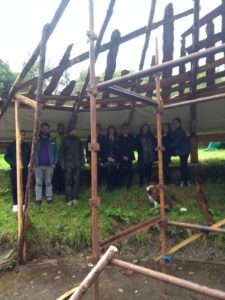
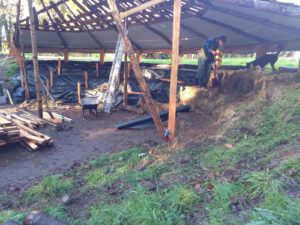

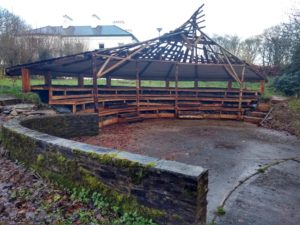
All the photos above show the process of renewing an old amphitheatre in St. Columb’s Park House, Derry. It was an initiative of the local teenagers, Park Youth, with their supervisor Darragh. I was also ably assisted in the wooden construction by David Monty. Completed in March 2020.
………………………………………………………………………………………………………………………………………………
This building pictured below was built by myself and James Hunter, with great help from Lorna and Conor. It was built in rough sandstone from Mountcharles, and took 30 days to build. As it slopes in wards on the outside, as the wall becomes the roof, so it leans inwards on the inside.
The job came about after completing a basketmaking course at White Oaks Rehab Centre, Near Muff on the ‘border’. The visionary priest Neil Carlin had designed a Saints of Ireland Peace Garden walk through a Bog, and St. Columba’s Cell is only one of a number of structures dedicated to Irish Saints.
The second picture shows better the construction methods used, if indeed there was such a thing. Indeed, my mentor/helper James didn’t carry a tape or spirit level! No hard hat either!!
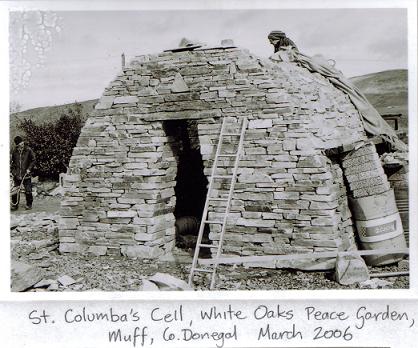
Reaching our Zenith with St. Columba
I am now sitting in a wee house made of a Timber Frame, and insulated with Hemp&Lime. It is small, and is very cosy. Its environmental credentials include Hemp, which sequesters carbon, although it was sourced in England, and all the other materials were sourced locally. I built it myself, but certainly not single-handed, and have my bros-in-law especially to thank. The following photos will provide a simple how-to.
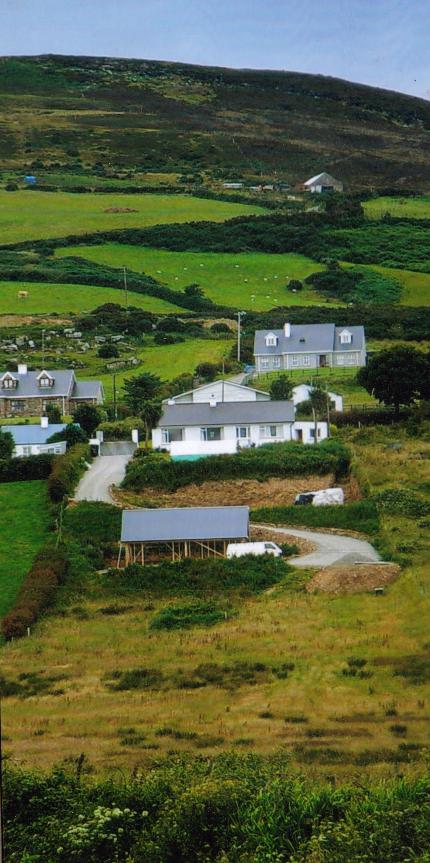
This is a photo of the land belonging to my father Willie Farren, with his house at the top (beside the gates) with the site he gave us below that and the workshop with timber frame and grey corrugated roof. This site is situated close to the most Easterly point of Co. Donegal, Inishowen Head.
I have been interested in building with natural materials for years, and having obtained planning permission for a house and workshop, I decided to build the workshop first with hemp and lime.
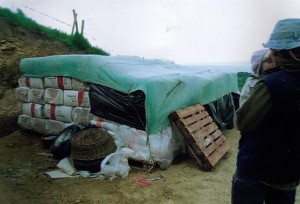
We ordered the materials from England, as it was difficult to obtain hemp in Ireland at that time.Lime technology provided both, and I knew of a lorry coming back half empty.
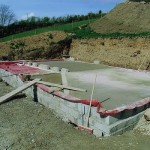
We laid down a concrete slab with radon barrier as is typical for a standard structure.
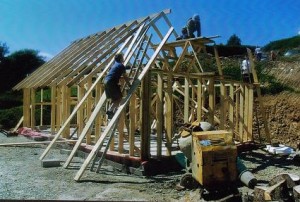
 We were blessed with amazing sunny weather in May 2008 to erect the timber frame and roof and then put the roof on first before we started filling in the walls. A huge thank you to Marion and Flor who travelled up from Gort, Co. ~Galway, to help with the roof. And of course to Sean Big Buns O’hara for all of his help. He’s left the country now.

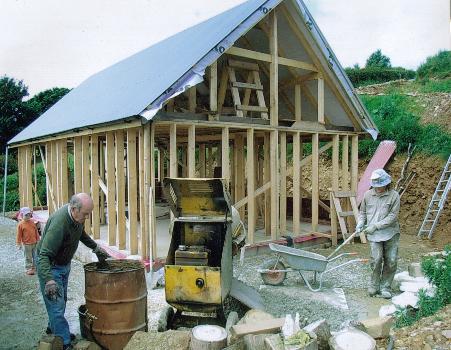
This was a family affair.From the left, Eoghan, Willy and Brendan Farren.
We then set up the plywood shuttering on either side of the timber frame, 100mm onthe outside of the 150mm timber, and 50mm on the inside, giving a total wall thickness of 300mm. The plywood was kept away from the timber frame with plastic piping.
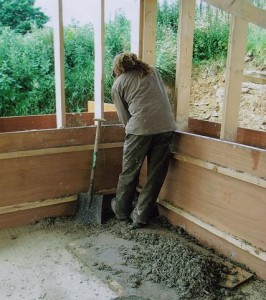
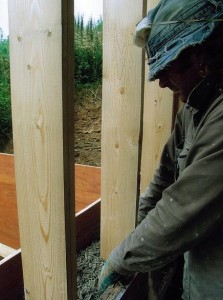 Using a conventional one-bag diesel mixer, I mixed half a bale of hemp shiv (12.5kg) with a bag of hydraulic lime (25kg) and 2-3 buckets of water, until i got a mix resembling porridge! It takes a bit of messing to get the right mix in a vertical mixer. Then the mix was shovelled into buckets and emptied into the shuttering, and tamped with a stick or even just by hand. Not too hard! The mix is also the insulation and needs to retain some air. When the shuttering is full to the brim, it is left overnight.
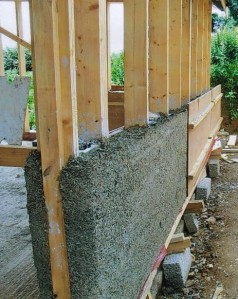
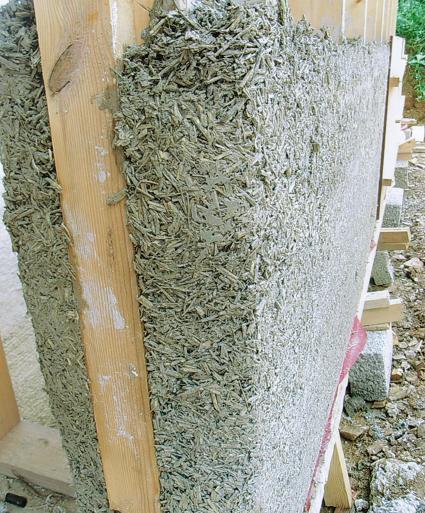
The walls set almost immediately, but need a long time to dry out completely. Having the roof on at this stage is important, and covering fresh walls against driving rain is a good idea.

It is fantastic being able to shape the walls- here i’m rounding off the window reveals with a knife.
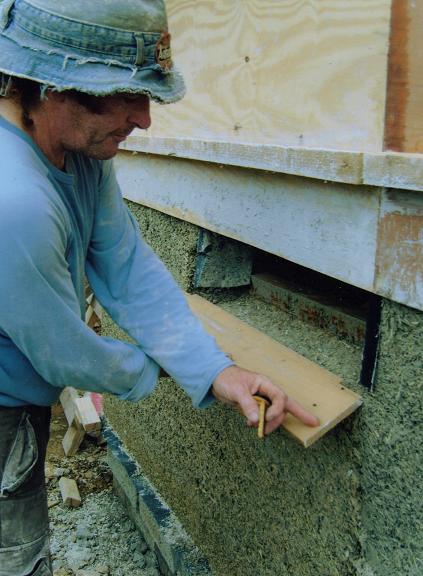
Window cills can be tropical hardwood (I used a pallet) or slate would be another option. This material doesn’t need lintels, but I think it’s a good idea, even a thin slice of tropical hardwood.
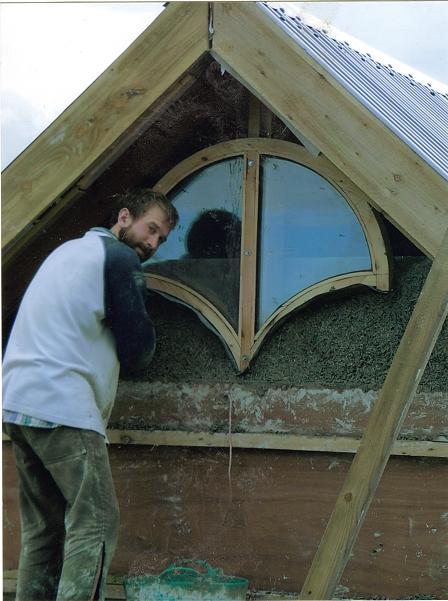 This is Seb, from Dublin, who was the only ‘stranger’ who gave us three days of his time. He was interested in the job and was contemplating a self-build in the near future.

My son Eoghan was keen to get stuck in, but I insisted on big gloves for this plastering job. The mix was 4:1 sand to hydraulic lime NH5, a scratch coat, then final coat.
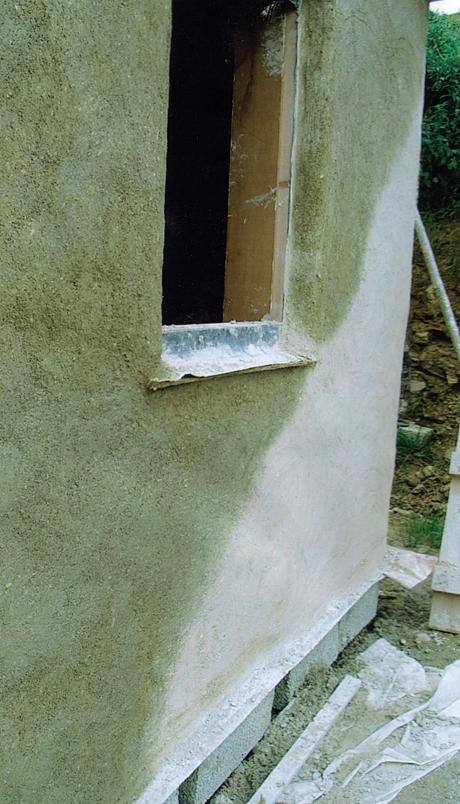
This shows the relative drying time of the hemplime and lime plaster. The walls are really interesting how they dry out. For the first few months after moving in (Jan.’09) there were tiny beads of water on the inside walls, yet the atmosphere was incredibly dry, it would almost take your breath away!